Compensation – The Line of Actual Control

The EU just passed a major AI law, China’s taking one stance on AI-generated art, and Japan’s trying to protect creators. Lawsuits abound! Here a quick round up from my readings this morning. 

The battle is for compensation.

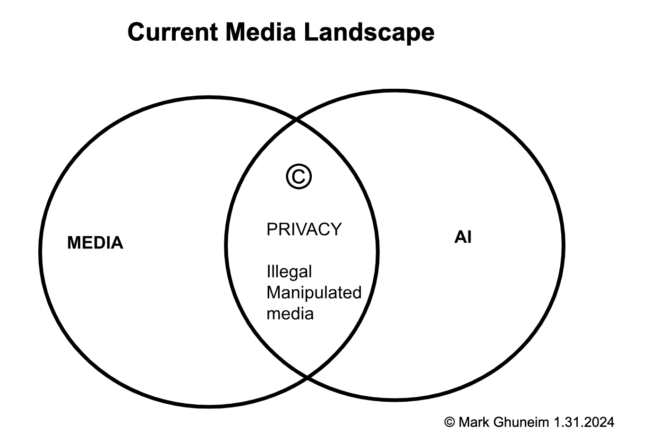
OpenAI says it’s impossible to train their amazing models without using books, art, music – basically everything created by humans. The market is forcing attribution in latent space.The need is for a mechanism for tracking and documenting contributions to latent representations of creative works.

EU parliament approves landmark AI law 

Companies using generative AI or foundation AI models like OpenAI’s ChatGPT or Anthropic’s Claude 2 must provide detailed summaries of any copyrighted works, including music, used to train their systems.  Training data sets used in generative AI music or audio-visual works must be watermarked for traceability by rights holders. Content generated by AI must be clearly labeled as such, and tech companies must prevent the generation of illegal and infringing content.  Interestingly The utilization of copyrighted materials in constructing AI models might be construed as a necessary “temporary act of reproduction,” integral to a technological process. 

China – Stable Diffusion China ruling

The Beijing Internet Court’s first instance judgment on AI-generated artwork from Stable Diffusion marked China’s first ruling on such creations, finding copyrightable elements. In contrast, the US Copyright Office in February 2023 deemed images generated by the AI drawing tool Midjourney ineligible for copyright, emphasizing human authorship.

France

The French government is currently investing 1.5 billion euros into AI, and has championed a so-called “open source” approach. The French government is currently investing 1.5 billion euros into AI, and has championed a so-called “open source” approach.  

Japan

The Cultural Affairs Agency in Japan has launched a data collection initiative to track copyright infringement cases related to the development and use of generative artificial intelligence (AI). This effort aims to address concerns among creators about AI generating large volumes of texts and illustrations resembling their original works.

Data will be gathered through a legal consultation service website, where creators can seek advice from agency-appointed lawyers on copyright-related issues at no cost. Since 2018, revisions to the Copyright Law have allowed the use of copyrighted materials for AI training without explicit permission, leading to protests from rights holder groups. Despite this, a lack of data on AI-related copyright infringement cases and court precedents has hindered discussions on potential law revisions.

The big picture 

There 23 active lawsuits underway, including recent cases against Nvidia (Authors for using the Books3 dataset)

Patronus AI conducted research testing leading AI models for copyright infringement using copyrighted books. The results for OpenAI’s GPT-4 produced the highest amount of copyrighted content, responding to 44% of prompts with copyrighted text. Other models also generated copyrighted content, with varying frequencies.  OpenAI has defended its use of copyrighted works, stating that it’s impossible to train top AI models without such materials arguing that limiting training data to public domain works from over a century ago would not meet the needs of modern AI systems. 

The issues revolve around fair use versus infringement, with companies like OpenAI arguing that training models on copyrighted data constitutes fair use, while copyright holders advocate for compensation, consent, and attribution.   This is likely to impact the market with one outcome seeing AI offerings paying license fees to rights holders or even opting to use pure synthetic data as an reach around. 

Seeing this weeks forward guidance from Adobe on quarterly revenues is an indicator of the legal headwinds and market complexities all these companies will be facing in the coming months. In Adobe’s case their product is crap (imho) These facts further inform my take that the earliest we will see meaningful impact to earnings will be north of Q1 2025.  Sans the chip sector and data centers that deals in the currency AI needs.

Getting the attribution balance right

Provenance and Originality: Attribution in latent spaces could help trace the evolution and lineage of creative works that have been generated or modified using AI. Suppose an image was generated from an initial latent code that was then iteratively modified. Attribution techniques could identify the contribution of each step, potentially aiding in determining ownership and rights over the final work. 

All that said deeply auditable latent space is not a thing right now. Extracting reliable stylistic fingerprints or interpreting latent space watermarks is complex and frankly its an active area of research not at a go to market place and all of it depending on watermarking, style fingerprint and metadata tracking being systematically implemented across models.  Read that paragraph twice and think about the likely hood of it being realized and enforced in the current market conditions It make ones head explode.  

Transformative Use: Understanding which elements within latent space are needed to establish a work’s identity is relevant to copyright’s “fair use” doctrine. AI modification of existing works might be considered transformative if it significantly alters the meaning or message expressed within the latent representation. All those Richard Prince court cases on process and new derivative works come to mind here…

Attribution to Compensation 

Attribution could help define the boundaries of what constitutes a significant change. Derivative Works: If a latent code is considered substantially derived from a copyrighted work, using that latent code to generate new outputs intersects with the IP of the copyright holders rights. 

Attribution can help determine the extent of similarity between latent representations and their potential sources.  Attribution adds technical proof to a copyright claim.

IP experts have differing views on how copyright law should apply to latent representations as the cases being argued in courts articulate. Copyright law hasn’t caught up with the complexities of AI-generated content,  making it difficult to apply traditional concepts like authorship and originality to works derived from latent spaces. Plus the high-dimensionality of latent spaces presents technical challenges for attribution, and there’s no clear agreement on who holds copyright for latent representations or the role of AI models in generating them.


We are here. 


MED Vol.30, No.75

Automakers Are Sharing Consumers’ Driving Behavior With Insurance Companies  (NYT) LexisNexis, which generates consumer risk profiles for the insurers, knew about every trip G.M. drivers had taken in their cars, including when they sped, braked too hard or accelerated rapidly.  Chicco v. General Motors LLC (9:24-cv-80281)

If you “buy” a digital movie on Amazon, but Amazon removes the movie from its library when Amazon’s license expires, did you really buy it? (x)

Just because your favorite singer is dead doesn’t mean you can’t see them ‘live’ (NPR). Pepper’s Ghost.

Viola the Bird   (Google Arts..) and if you are not cooking up your creative side at their AI Test Kitchen you should be

UN AI advisory feedback RFC  (UN.org). 15 days left.

The Rough Years That Turned Gen Z Into America’s Most Disillusioned Voters (WSJ)

Concord Music Group, Inc. v. X Corp (court listener)

Artificial Intelligence Policy Act – Enacted (UT)

AI Utah Law as of May 1. 2024

ARTIFICIAL INTELLIGENCE AMENDMENTS 2024 GENERAL SESSION STATE OF UTAH

The law introduces the Artificial Intelligence Policy Act, defining terms related to AI and establishing legal liabilities for its misuse.

It creates an Office of Artificial Intelligence Policy, a regulatory AI analysis program, and mandates AI disclosures in regulated occupations. The act also sets up an AI Learning Laboratory Program for technology assessment and policy evaluation, granting rulemaking authority over AI programs and regulatory exemptions.

The bill emphasizes consumer protection in AI interactions and outlines penalties for violations, aiming to balance innovation with regulatory oversight, effective May 1, 2024.

These include

  • Disclosure: The bill requires businesses to disclose when consumers are interacting with AI. This is intended to help consumers understand who they are interacting with and what information is being collected about them.

  • Liability: The bill establishes liability for businesses that misuse AI. This could include cases where AI is used to discriminate against consumers, make false or misleading statements, or invade consumers’ privacy.

  • Regulatory office: The bill creates a new Office of Artificial Intelligence Policy. This office will be responsible for overseeing the implementation of the bill and developing new regulations for AI.

A provision exists that allows participants who use or plan to use artificial intelligence technology in Utah to apply for “regulatory mitigation.”

FTC: Rule on Impersonation of Individuals

The Federal Trade Commission (FTC or Commission) requests public comment on its proposal to amend the trade regulation rule entitled Rule on Impersonation of Government and Businesses (Impersonation Rule or Rule) to revise the title of the Rule, add a prohibition on the impersonation of individuals, and extend liability for violations of the Rule to parties who provide goods and services with knowledge or reason to know that those goods or services will be used in impersonations of the kind that are themselves unlawful under the Rule.

The agency is taking this action in light of surging complaints around impersonation fraud, as well as public outcry about the harms caused to consumers and to impersonated individuals. Emerging technology – including AI-generated deepfakes – threatens to turbocharge this scourge, and the FTC is committed to using all of its tools to detect, deter, and halt impersonation fraud.

Statement of Chair Lina M. Khan expands on AI’s impact

The rise of generative AI technologies risks making these problems worse by turbocharging scammers’ ability to defraud the public in new, more personalized ways. For example, the proliferation of AI chatbots gives scammers the ability to generate spear-phishing emails using individuals’ social media posts and to instruct bots to use words and phrases targeted at specific groups and communities.7 AI-enabled voice cloning fraud is also on the rise, where scammers use voice-cloning tools to impersonate the voice of a loved one seeking money in distress or a celebrity peddling fake goods.8 Scammers can use these technologies to disseminate fraud more cheaply, more precisely, and on a much wider scale than ever before.

A summary of the changes…

Proposed Changes to the Impersonation Rule

Title Change: To reflect the broader scope of the rule, including the impersonation of individuals alongside businesses and government entities, the title is proposed to be changed to “Rule on Impersonation of Government, Businesses, and Individuals.”

Definition of “Individual”: The addition of a definition for “Individual” to mean any person, entity, or party, real or fictitious, other than those constituting a business or government. This aims to clarify the types of impersonation prohibited.

Prohibition of Individual Impersonation: Introduction of a new section, “Impersonation of Individuals Prohibited,” to explicitly prohibit impersonation of individuals in commerce, mirroring existing prohibitions against impersonating government entities and businesses.

Provision of Goods or Services for Unlawful Impersonation: A new section to make it unlawful to provide goods or services with knowledge, or reason to know, that they will be used in impersonation scams. This amendment seeks to address concerns about broad interpretation and potential imposition of strict liability on unaware third parties, by including a knowledge requirement.

Impact Across Sectors

The language that extends liability — would impact entities that provide goods and services used in impersonation scams, knowingly or with reason to know, are held liable under the proposed amendments. This would include telecommunications companies to social media platforms, essentially any service that could be used as a means or instrumentality for impersonation. The proposal emphasizes a knowledge component to prevent undue liability on those unknowingly involved, aiming to balance the enforcement of rules against scammers with the legitimate operations of businesses.

Get your comments in during the window

Embodied, Perceptive, Realtime AI

Over the past couple of months I found myself thinking about what does Realtime AI looks like in practice. Somewhere between the swarm behavior that takes place in applications like Waze or citizen app that collects incoming information around a specific event as it happens.

There’s also the real time of perception, and how does AI in practice allow humans to perceive the environments around them starting with our own five senses senses and then other heads of data of the environment, situational awareness, etc.

I came across this paper that calls for embodied AI that wants to crate a foundational guideline for future E-AI research. Highlighting the importance of creating E-AI agents capable of seamless communication, collaboration, and coexistence with humans and other intelligent entities within real-world environments..