European Parliament Members Reach Provisional Agreement on Groundbreaking AI Act

Members of the European Parliament (MEPs) have provisionally agreed on the world’s first rulebook for artificial intelligence (AI), known as the AI Act. This legislation aims to regulate AI based on its potential for harm. The formalization of the Parliament’s position is imminent, with a committee vote scheduled for 11 May and a plenary vote in mid-June.

Key points from the Act include:

  1. General Purpose AI: The Act puts stricter regulations on foundation models, such as ChatGPT, which are AI systems that do not have a specific purpose. Generative AI models would need to comply with EU law and fundamental rights, including freedom of expression.
  2. Prohibited practices: Certain AI applications deemed to pose unacceptable risks are banned. These include AI-powered tools for general monitoring of interpersonal communications, biometric identification software (with certain exceptions for serious crimes), purposeful manipulation, emotion recognition software in certain domains, and predictive policing for administrative offenses.
  3. High-risk classification: AI solutions that pose a significant risk of harm to health, safety, or fundamental rights will be classified as high-risk, requiring them to follow stricter regulations, including risk management, transparency, and data governance. AI used to manage critical infrastructure will also be deemed high-risk if they present a severe environmental risk.
  4. Detecting biases: Providers of high-risk AI models can process sensitive data to detect negative biases, but under strict conditions. The processing must happen in a controlled environment, the data must not be shared with other parties, and it must be deleted after the assessment.
  5. General principles: All AI models should adhere to principles including human agency and oversight, technical robustness and safety, privacy and data governance, transparency, social and environmental well-being, diversity, non-discrimination, and fairness.
  6. Sustainability of high-risk AI: High-risk AI systems and foundation models will have to comply with European environmental standards and keep records of their environmental footprint.

The The EU AI Act Newsletter #28 has an up-to-date developments and analyses of the proposed EU artificial intelligence law.


The US who has been standing still on enacting legislation and a lot of whats adopted has roots in EU legislation. Looking at a high-level comparison of the EU and U.S. positions on AI regulation.

EU and U.S. Positions on AI Regulation: A Comparison

EU Approach:

  • Comprehensive legislation tailored to specific digital environments
  • New requirements planned for high-risk AI in socioeconomic processes, government use of AI, and regulated consumer products
  • Emphasizes public transparency and influence over AI system design in social media and e-commerce

U.S. Approach:

  • Highly distributed across federal agencies without new legal authorities
  • Investments in non-regulatory infrastructure, such as AI risk management framework and evaluations of facial recognition software
  • Risk-based approach but lacks consistent federal approach to AI risks

Alignment and Misalignment:

  • Conceptual alignment on risk-based approach, key principles of trustworthy AI, and importance of international standards
  • Significant differences in AI risk management regimes, especially in socioeconomic processes and online platforms

Collaboration:

  • EU-U.S. Trade and Technology Council: Successful collaboration on metrics, methodologies, and international AI standards
  • Joint efforts in studying emerging AI risks and applications

Recommendations for Alignment:

  • U.S.: Execute federal agency AI regulatory plans, design strategic AI governance with EU-U.S. alignment, establish legal framework for online platform governance
  • EU: Create flexibility in sectoral implementation of EU AI Act, improve law for future EU-U.S. cooperation

The  Brookings Inst offers this framing on the US approach

Regarding the U.S. federal government’s approach to AI risk management, it is characterized as risk-based, sectorally specific, and highly distributed across federal agencies. However, the development of AI policies in the U.S. has been uneven.

While there are guiding federal documents on AI harms, they have not created a consistent approach to AI risks. Federal agencies have not fully developed the required AI regulatory plans, with only a few agencies having comprehensive plans in response to the requirements.

The Biden administration has shifted focus from implementing Executive Order 13859 to the Blueprint for an AI Bill of Rights (AIBoR), developed by the White House Office of Science and Technology Policy (OSTP).

The AIBoR endorses a sectorally specific approach to AI governance, relying on associated federal agency actions rather than centralized action. However, the AIBoR is nonbinding guidance​


F2-NeRF: Fast Neural Radiance Field Training with Free Camera Trajectories

Todays paper F2-NeRF: Fast Neural Radiance Field Training with Free Camera Trajectories which is a mouthful.  Lets break this one down to production talk.

This bad boy allows a filmmaker, interested in creating virtual scenes or generating novel views of a scene from different camera angles. It’s a framework that can synthesize high-quality images of a scene from various camera viewpoints, even ones that weren’t originally captured.  Boom!

Moreover, F2-NeRF is fast—it can be trained in just a few minutes, which makes it practical for use in filmmaking and animation workflows. Think of it as a powerful tool for creating dynamic and visually compelling virtual environments in your films.

As for the training data, F2-NeRF is trained on images (not videos or text) and leverages a technique called “Neural Radiance Fields” to learn how to generate new views of a scene based on the images provided. This allows it to produce high-quality renderings from any desired camera viewpoint.

https://arxiv.org/abs/2303.15951
https://totoro97.github.io/projects/f2-nerf/

AI risk regulation frameworks:


AI risk regulation frameworks:

Singapore’s Model AI Governance Framework: Soft law focused on explainable, transparent, and human-centric AI decision-making.

The Draft EU AI Act: Hard law that classifies AI systems into unacceptably risky, high-risk, and low-risk uses, and implements risk regulation for high-risk AI systems.

NIST’s AI Risk Management Framework (U.S.): Soft law that emphasizes enterprise risk management and an iterative approach to risk management.

Text to Entertainment

This is my current area focus if you’re digging here please get in touch.

I am excited about the potential of this medium to offer meaningful and captivating experiences. To further explore the possibilities of generative storytelling and to contribute to the growth of this emerging field.

Browsing Shift

There are volumes to be written on the shift in browsing and publishers new challenges around IP – but this is not that. A fastshort observation about the browsing version of ChatGPT. It often surfaces urls – new to me and refreshing resources that have been unaware of.

Today when asking for a news summary it referred to this alt view of hckrnews.com which was nice as my other alt view hack.ernews.info stopped working.

Copyright and Artificial Intelligence

The Copyright Office has issued a new policy statement regarding the registration of works containing material generated by artificial intelligence (AI). Providing guidance on how to submit applications for copyright protection for works that contain AI-generated material, and how to correct previously submitted or pending applications.

Key points

  • Individuals who use AI technology in creating a work may claim copyright protection for their own contributions to that work.
  • The Standard Application must be used, and in it, applicants must identify the author(s) and provide a brief statement in the ‘‘Author Created’’ field that describes the authorship that was contributed by a human.
  • Applicants should exclude AI-generated content that is more than de minimis in the application, by providing a brief description of the AI-generated content under the ‘‘Material Excluded’’ heading in the ‘‘Limitation of the Claim’’ section.
  • Applicants who fail to update the public record after obtaining a registration for material generated by AI risk losing the benefits of the registration.
  • If necessary, the examiner will correspond with the applicant to obtain additional information about the nature of the human authorship included in the work.
  • The supplementary registration process may be used to correct errors in a copyright registration or to amplify the information given in a registration, including the exclusion of AI-generated content
  • The policy statement reflects a major change in the way copyright law addresses works containing AI-generated material.

The Copyright Office will host public listening sessions throughout the spring of 2023, with the following dates:

Literary Works on Wednesday, April 19, from 1:00 p.m. to 4:00 p.m. ET

Later in the year, the Copyright Office plans to publish a notice of inquiry soliciting public comments on a wide range of copyright issues arising from the use of AI.  The Copyright Office will continue engaging with the public through informational webinars during the summer.

The Intersection of Technology and Information Theory

Abstract: This paper explores the alignment of digital interfaces with our existing innate encoding and decoding of information.

The focus is on “front door” moments in technology, where new interfaces or technologies fundamentally change the way we interact with information and the world around us.

Top 10  “front door” moments in technology and information theory, along with a short description and the year the technology became broadly available:

  1. Web browsers (1993) – The development of the first web browsers, including Mosaic, provided users with a way to access and navigate the web.
  2. Search engines (1995) – The emergence of search engines, such as Yahoo and AltaVista, made it easier for users to find information on the web.
  3. Site maps (1998) – The development of site maps, which provided a visual representation of a website’s structure and content, made it easier for users to find what they were looking for.
  4. Social media (2003) – The emergence of social media, such as MySpace and LinkedIn, provided new ways for users to access and share information.
  5. GPS data (2009) – Foursquare’s use of GPS data to put a “doorway and face” on location information provided users with a new way to access and share information about their location.
  6. Mobile devices (2007) – The emergence of smartphones, such as the iPhone and Android, required the development of new and innovative interfaces that could accommodate smaller screens and limited processing power.
  7. Big data (2010s) – The emergence of big data and the development of tools and techniques for processing and analyzing large amounts of information provided new ways to access and process information.
  8. AI and machine learning (2010s) – The development of AI and machine learning has enabled new approaches to information retrieval and processing, with significant advances in recent years.
  9. Blockchain (2009) – The emergence of blockchain technology and its potential to create new and secure ways to exchange and verify information is an example of a new “front door” to information exchange.
  10. Text and voice to AI UI (2010s) – The development of natural language processing and speech recognition technologies has enabled new ways for users to interact with AI systems in a more intuitive and natural way, opening up new “front doors” for effective communication and collaboration.
 (c) Mark Ghuneim 202

Generative Entertainment Milestones

Generative Entertainment Milestones  In chronological order.  

Milestones

  1. 1956: The first computer-generated music is created by an IBM computer in Australia.
  2. 1966: The Yule Log TV, a holiday program featuring a looping video of a burning fireplace, debuts on WPIX-TV in New York City.
  3. 1979: The first video game with procedural generation, Rogue, is released.
  4. 1982: The Weather Channel begins broadcasting, featuring generative content such as weather maps and graphics.
  5. 1985: Max Headroom, a television series featuring a computer-generated character, debuts on HBO.
  6. 1998: Brian Eno releases “Generative Music 1,” a music album generated by a software program that creates music in real time.
  7. 2011: “Hip Hop Beats to Study/Relax to” YouTube channel is created, featuring 24/7 live streaming of lo-fi hip hop music with generative visuals.
  8. 2016: “Radio Garden,” a web-based platform that allows users to listen to live radio stations from around the world, features a generative interface that shows a spinning globe and allows users to navigate to different locations.
  9. 2017: “The Infinite Now,” a short film created by filmmaker Armand Dijcks and photographer Ray Collins, features generative visuals that create a sense of infinite movement in a series of still images.
  10. 2022: Genuary is held for the second time, featuring a range of generative art and creative coding challenges. (c) Mark Ghuneim 2023

Moments

  1. “Nothing, Forever” – a generative storytelling experiment using Twitch as the platform.
  2. “AI Dungeon” – an interactive storytelling game that uses AI-generated text to create dynamic storylines.
  3. “Minecraft” – a popular video game that allows players to create and explore procedurally generated worlds, and has also been used to host virtual events such as the Travis Scott Concert.
  4. “Google DeepDream” – a software that uses deep learning algorithms to transform images into dream-like, hallucinogenic visuals.
  5. “Infinite Jest” – a novel by David Foster Wallace that features numerous generative elements, such as a filmography of made-up movies and a detailed timeline of future events.
  6. “AIVA” – an artificial intelligence program that composes original music in a range of styles and genres.
  7. “The Infinite Album” – a music album created by musician Bryce Dessner that features generative elements that change each time the album is played.

As we venture into uncharted territory in the realm of synthetic media, it’s important to provide clear definitions and vocabulary to help others understand and engage with the vision. (As someone who sees around corners, I learned this the hard way many times!!)

Looking back at the history of generative entertainment can provide a framework for moving forward in this new generative AI landscape beyond sorting, completion, summary etc and start to look at the tooling ++++ around creative uses

All Your Base is Ours

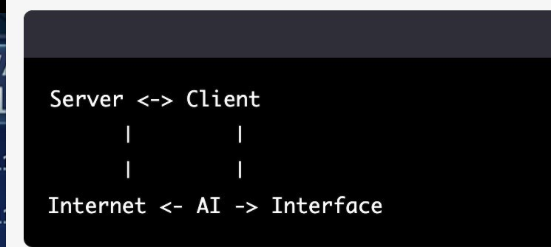
Internet trend: The frontend is becoming the backend AI is leading to a transformation of the internet as a whole, turning it into a powerful computational backend for new, robust interfaces.
This is happening fast. The front door has moved from click to text. The full corpus of the internet is being arbitraged. and represented. This is massive UX/UI shift thats being adopted at rate not seen before in such sort order.
WEB3.0 - THERORY

WEB 3.0 THE INSIDE OUT – (C) MARKGHUNEIM

The UI has served to drive adoption, the doorway matters. The current W3 experience untenable. The speed to market prior to understanding the implications of what’s being used, how, what that looks like in a compensation model will be likely be the next ten years (sigh)
As we moved physical to digital whole parts were missed the transcoding crossing. The information that did and that has been created since, is now being transcoded once again this time by an AI that will represent it disembodied from source.  The information that did not make the initial crossing getting close to EOL in physical form.   

All that said the digital era of entertainment has unfolded in reverse not dropped down in constraint formats from media companies but have grown up from fertile ground created from bits, rendered and remixed, consumed in new ways for new pleasures and means of storytelling.

Just like music had to understand transcoding to new formats + consumption the whole internets IP is about to follow suit, distributed, disembodied and abstracted from source.’
It turns out one of the foundational memes during Web 1.o “all your base was belong to us” was taken as instructive for web3.0