Cindy Sherman training an AI and using it to generate work.
Comments from peers in both approval and speaking
about experimenting themselves.

Cindy Sherman training an AI and using it to generate work.
Comments from peers in both approval and speaking
about experimenting themselves.


The use of chatGPT, a large language model trained by OpenAI, raises a number of ethical and privacy concerns, including:
Bias: chatGPT is trained on large amounts of data, which can potentially include biased or discriminatory information. This could lead to biased or unfair outputs from chatGPT, which could have negative impacts on individuals or groups.
Accountability: chatGPT is a machine learning system that operates autonomously, without direct human oversight or control. This means that it can be difficult to hold chatGPT accountable for its actions or outputs, and it can be challenging to understand and explain the reasons behind its decisions and recommendations.
Control: chatGPT’s ability to process and analyze large amounts of data, and to provide instant and personalized responses, means that it can potentially have a significant influence on individuals and organizations. This could raise concerns about who has control over chatGPT and its outputs, and who is responsible for ensuring its ethical and responsible use.
Privacy: chatGPT processes and stores large amounts of personal and sensitive data in order to operate and provide assistance. This data could potentially be accessed or misused by unauthorized individuals or organizations, leading to privacy breaches and other risks.
Transparency: chatGPT operates using complex algorithms and mathematical models, which can be difficult for non-experts to understand and interpret. This lack of transparency could make it difficult for individuals and organizations to understand how chatGPT makes decisions and provides recommendations, and could limit their ability to verify or challenge its outputs.
Overall, these ethical and privacy concerns highlight the need for careful and responsible use of chatGPT and similar technologies, and for the development of appropriate regulations, guidelines, and standards to ensure their ethical and accountable use.
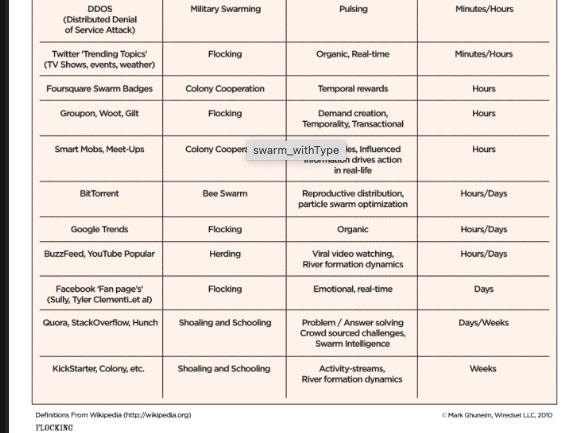
Back during the web 2.0 era circa 2011 I wrote and spoke about swarm behavior, specifically about attention swarms around media.

As the AI era of the web emerges we see that swarm continues to inform. In this post Collective Intelligence for Deep Learning: A Survey of Recent Developments – the section on image generation using collective intelligence helps solidify that swarm is the flow to know. This example with unique constraints that act as catalysts for collaboration in particular.
We’ll start by discussing the idea of image generation using collective intelligence. One cool example of this is a collective human intelligence: the Reddit r/Place experiment. In this community experiment, Reddit set up a 1000×1000 pixel canvas, so reddit users have to collectively create a megapixel image. But the interesting thing is the constraints Reddit had imposed: each user is only allowed to paint a single pixel every 5 minutes:
This experiment lasted for a week, allowing millions of reddit users to draw whatever they want. Because of the time constraint imposed on each user, in order to draw something meaningful, users had to collaborate, and ultimately coordinate some strategy on discussion forums to defend their design, attack other designs, and even form alliances. It is truly an example of the creativity of collective human intelligenc
Understanding swarm behaviors both macro and micro in all aspects of learning and behavior continues to be important
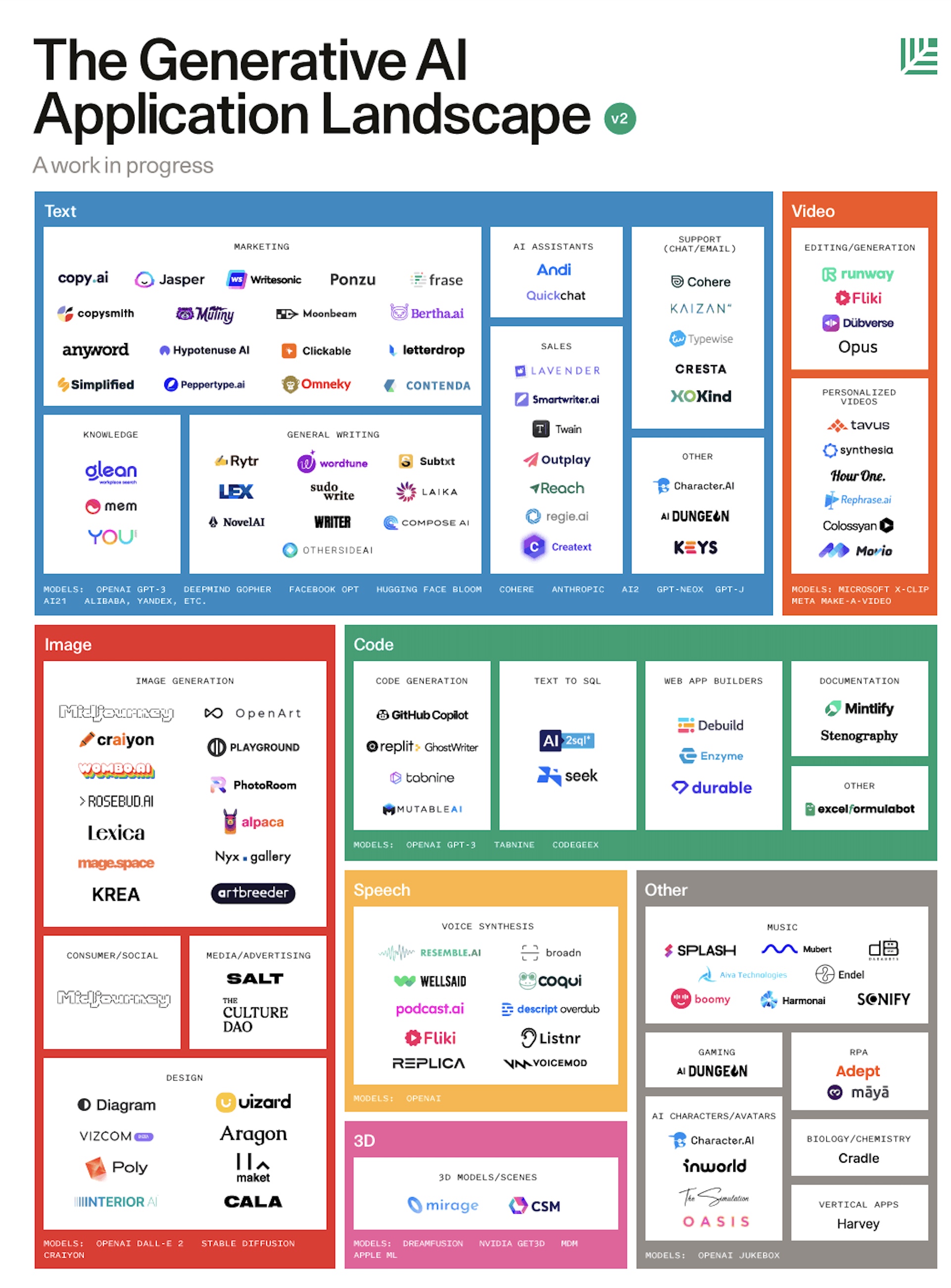
The Generative Al Application Landscape
Link to full res image The Generative Al Application Landscape revised from sequoia capital.
Which areas are the richest to further empathy, knowledge, thinking, ideation, creation….
Random notes and links
…and why I have been thinking a wiki or a Digital Garden might be useful
Paul Graham “A person I have known for more than ten years, who I consider trustworthy, is convinced the cryptocurrency economy will shortly experience a systemic risk. I don’t know anything concrete, but if I were exposed, I would be concerned.” OTH Bill Ackerman believes “that crypto can enable the formation of useful businesses and technologies that heretofore could not be created. The ability to issue a token to incentivize participants in a venture is a powerful lever in accessing a global workforce to advance a project”
FT’s Jo Ellison —Abba, The Crown and deep-fake entertainment “But while many are now exploring the limits of what can be done to bend an audience’s perception, there is also a growing contingent who still crave the corporeal and real.”
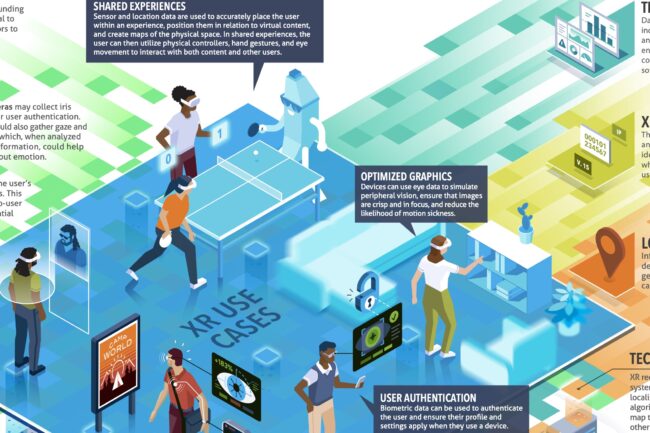
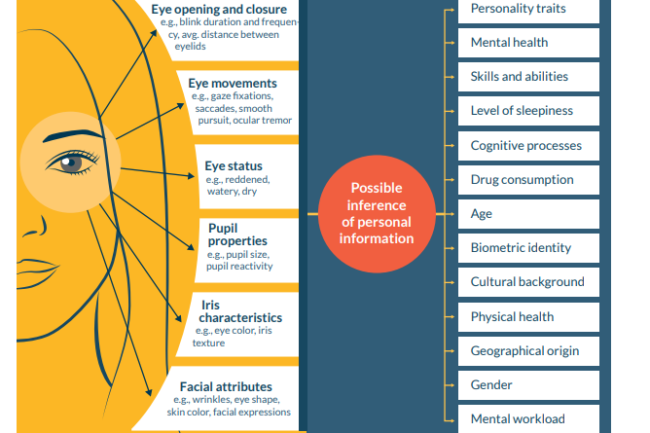
Surveillance Too Cheap to Meter. We should tax surveillance data it is free now.
Mesh tool?
Briarproject.org/how-it-works/
When we went digital, a disturbing aspect for creators of art was the loss of agency over when their work is released. e.g…leaked by others when it may or may not be finished The marketplaces that allow for these windows are no friends of art. They are exploitative and do not respect the creative process. Hilma af Klint’s family criticises the NFT sale of the artist’s sacred paintings. The Swedish artist’s family say the digital drop contradicts the artist’s will and goes against her artistic intentions
QOTD
This quote from Alcuin c.735–804 English scholar and theologian seems right for today in light of Space Karen‘s destruction of Twitter… ec audiendi qui solent dicere, Vox populi, vox Dei, quum tumultuositas vulgi semper insaniae proxima sit. letter 164 in Works (1863) vol. 1 “And those people should not be listened to who keep saying the voice of the people is the voice of God, since the riotousness of the crowd is always very close to madness”
Lexicon…
The EFF series on Mastodon and the fediverse.
Algospeak NYT- How TikTok Is Changing Language
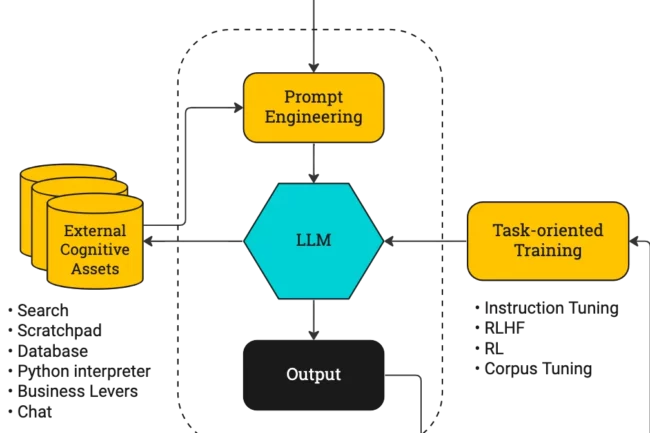
The Near Future of AI is Action-Driven Excellent framing of the here and now and what’s next.

Link round up
SkyPilot: Run ML and Data Science jobs on any cloud, with massive cost savings.
DREAM.page AI-first blogging platform
humanloop has a playground that brings variable interpolation to prompts and lets you turn them into API endpoints
@everyprompt a pretty good playground for large language models like GPT-3.
LangChain 0.0.7: All relevant chains now have a “verbose” option to highlight text according to the model or component (SQL DB, search engine, python REPL, etc) that it’s from. Should be super helpful for understanding/debugging the chain!
Spellbook from Scale_AI
http://deck.rocks AI generated startup pitch decks. (humor?)
dust4ai A collapsible tree UI for representing k-shot example datasets, prompt templates, and prompt chaining with intermediate JS code
Non ML/AI
IDEA – REF FRAMES – AGI
WHAT: The impunity to look at a specific subject instance or occurrence that takes place and be able to understand it over time and continuously have it be a pampered new information.
HOW:
1. Look at the subject instance or occurrence and identify what aspects of it are important to understanding it over time.
2. Create a frame of reference for each important aspect, specifically referring to how it changes over time.
3. Use the frames of reference to understand the topic
8. Update frames of reference recursively include:
9. Using a data structure that allows for the finding of “traits of thoughts” or threads that illustrate new or deeper information on topic by topic basis.
10. Encapsulating new information in a way that is easily digestible and can be related back to existing knowledge.
11. Organizing new information in a way that allows for easy retrieval and comparison with other related information.
Machine readable but one might also render a reference frame on a topic as visual by creating a diagram or chart that illustrates the different concepts related to the topic. This can help to provide a clear and concise overview of the information, and can make it easier to understand and remember. Additionally, using colors or other visual cues